
Vasectomy vs Tubal Ligation: Pros, Cons, and Public vs Private Coverage
Written by Dr Rahul Tipnis, FRACGP | Date: 6th September 2026
When a couple decides they have completed their family, permanent contraception often becomes the primary focus of their reproductive health planning. The two most common surgical options are vasectomy (male sterilisation) and tubal ligation (female sterilisation, often referred to as a tubectomy or "having your tubes tied").
While both procedures aim for long-term permanent contraception, they differ significantly in surgical approach, anaesthetic requirements, recovery times, and availability across public and private healthcare systems.
Comparing the Procedures
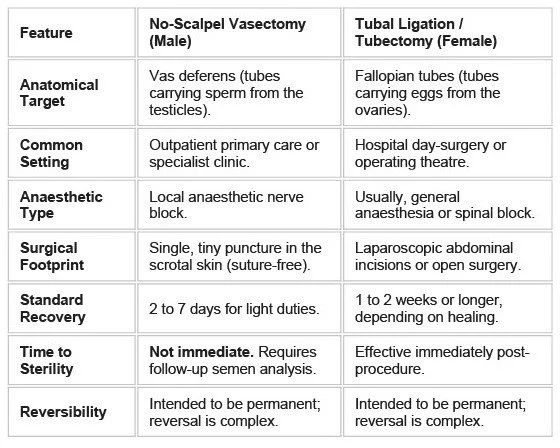
Clinical Considerations: No-Scalpel Vasectomy
A no-scalpel vasectomy is a minor outpatient procedure performed by accessing the vas deferens through a small, specialized puncture in the scrotal skin.
Advantages:
Lower Surgical Footprint: Performed as an outpatient procedure under local anaesthesia, avoiding the risks associated with general anaesthesia and abdominal entry.
Streamlined Recovery: Most patients return home immediately and resume desk work within 2 to 3 days.
Accessibility: Easily accessible in private outpatient clinic settings with shorter waiting times.
Considerations & Risks:
Not Effective Immediately: Sperm remain stored upstream in the reproductive system for weeks post-surgery. Alternative contraception must continue until follow-up pathology testing at 8 to 16 weeks confirms complete clearance (azoospermia).
Surgical Risks: Include localized bleeding, hematoma formation, infection, temporary swelling, post-vasectomy pain syndrome, and a low statistical risk of late spontaneous recanalisation (failure).
Clinical Considerations: Tubal Ligation (Tubectomy)
Tubal ligation involves interrupting, clipping, or removing sections of the fallopian tubes to prevent eggs from reaching the uterus.
Advantages:
Immediate Contraceptive Effect: Once the procedure is complete and tissue healing is verified, no follow-up laboratory clearance tests are required.
Convenience During Other Procedures: Can sometimes be scheduled concurrently with an elective Caesarean section.
Considerations & Risks:
Higher Surgical Footprint: Requires entry into the pelvic cavity, typically under general anaesthesia in a hospital setting.
Longer Recovery Profile: Abdominal soreness and recovery generally require 1 to 2 weeks before returning to normal activities.
Surgical Risks: Includes general anaesthetic risks, infection, abdominal bleeding, injury to surrounding pelvic organs, and a small risk of ectopic pregnancy if the procedure fails.
Medicare & Public Hospital Coverage in Australia
Understanding how Medicare and hospital systems fund these procedures helps couples plan effectively.
Tubal Ligation Coverage
Public Hospitals:100% covered by Medicare for public patients accepted into a public hospital. There are zero out-of-pocket procedure or anaesthetic fees.
Hospital Availability:Not all public hospitals perform elective tubal ligations. Access depends on regional surgical capacity, and hospitals operating under specific religious frameworks do not offer elective sterilisation services. Access requires a GP referral to a public hospital gynaecology clinic and placement on an elective surgery waitlist.
Private Hospitals: In a private hospital, Medicare and private health insurance (depending on your tier of cover) assist with costs, but out-of-pocket gap fees for the surgeon, anaesthetist, and hospital stay often apply.
Vasectomy Coverage
Public Hospitals: Access through public hospitals is extremely limited across Australia. Because vasectomies are low-risk minor procedures, public health networks generally triage them as low priority compared to urgent urological conditions, leading to long waitlists or non-acceptance of referrals in many regions.
Private Outpatient Clinics: Most men choose private outpatient clinics for timely access under local anaesthesia.
Medicare Rebate: In a private clinic setting, Medicare does not cover 100% of the cost. Medicare provides a partial rebate for eligible consultations and the procedure (under MBS item numbers), leaving a transparent out-of-pocket gap fee.
Making the Decision
Neither option is universally "better"—the choice depends on a couple's shared medical history, health status, personal preferences, and financial considerations.
Key points to evaluate together include:
Surgical Preference: Preference for a minor outpatient procedure under local anaesthetic versus a hospital procedure under general anaesthesia.
Recovery Requirements: Time off work, household duties, and childcare responsibilities.
Patience with Testing: Comfort with continuing alternative birth control for 3 to 4 months until follow-up semen testing is complete (vasectomy).
Permanence: Absolute certainty from both partners that no further biological children are desired, as both options must be approached as irreversible.
Practice Credentials & Safety Disclosures
Dr Rahul Tipnis (MBBS, MS, FRACGP) is a registered General Practitioner with an audited clinical record of over 200 no-scalpel vasectomies. He is not a specialist urologist or gynaecologist.
All surgical interventions carry inherent clinical risks. A formal pre-operative consultation is mandatory prior to scheduling a vasectomy. Alternative contraception must continue uninterrupted until a post-vasectomy semen analysis confirms complete clearance. Patients are always encouraged to seek an independent second opinion from an appropriately qualified health practitioner.
Arranging a Pre-Operative Consultation
If you and your partner wish to discuss no-scalpel vasectomy options, contact our clinical team in Melbourne’s west.
📞 Contact Circ Vas Doctor: 1300 714 358
📍 Clinic Location: Harmony Health Medical Centre, 46 Hogans Road, Hoppers Crossing VIC 3029
(Serving patients across Hoppers Crossing, Truganina, Tarneit, Werribee, Point Cook, and regional Victoria).
⚠️ Mandatory Medical Disclaimer
This webpage is published strictly for general educational purposes and does not substitute for direct medical diagnosis, advice, or a personalized treatment plan. All minor surgical procedures carry inherent clinical risks—including localized bleeding, hematoma formation, infection, temporary swelling, chronic pain, and a low statistical risk of failure or recanalisation. A formal, mandatory face-to-face clinical evaluation and consultation are required before any procedure can be scheduled. Dr Rahul Tipnis is a registered General Practitioner (FRACGP, AHPRA Registration: MED0001552566). No-scalpel vasectomy procedures are performed exclusively for verified family planning indications. Individual recovery outcomes vary. Patients are always encouraged to seek an independent second opinion from a qualified health practitioner regarding surgical interventions.
