
Medical Circumcision for Elderly Patients & Regional Travellers: Safety, Anticoagulants, and What to Expect
Written by Dr Rahul Tipnis, FRACGP | Date: 27/09/2026
As men age, severe medical foreskin conditions—most notably pathological phimosis (severe tightening or scarring of the foreskin) and recurrent balanitis—can significantly impact quality of life, hygiene, and urinary function. It is not uncommon for elderly patients, including men in their 80s, to seek surgical relief when non-surgical treatments fail.
When an older patient presents with complex comorbidities—such as Non-Valvular Atrial Fibrillation (NVAF), cardiovascular disease, or kidney impairment—and travels from regional Victoria (such as Daylesford, Ballarat, or Geelong), careful pre-operative planning is essential.
This guide outlines how minor surgical circumcisions under local anaesthesia (LA) are safely managed for older patients, how blood thinners like Apixaban are handled, and the strict safety boundaries for in-clinic procedures.
1. Managing Blood Thinners (e.g., Apixaban / Eliquis) Before Surgery
A major concern for older patients is whether they can undergo a minor surgical procedure while taking direct oral anticoagulants (DOACs) like Apixaban, Rivaroxaban, or Dabigatran for Atrial Fibrillation or deep vein thrombosis.
No Unnecessary Stopping: Anticoagulants should never be stopped without a structured medical assessment. Abrupt cessation increases stroke and thromboembolic risks.
Short-Term Discontinuation Protocol: Because minor circumcisions carry a low-to-moderate bleeding risk, clinical guidelines typically require withholding Apixaban for 24 to 48 hours before the procedure, depending on the patient's renal function (creatinine clearance).
No Heparin Bridging Required: Unlike older blood thinners (like Warfarin), DOACs have a short half-life and do not require complex bridging injections in most outpatient settings.
Post-Operative Restarting: Apixaban is generally recommenced 24 hours post-procedure, provided complete haemostasis (bleeding control) is confirmed.
2. Absolute & Relative Contraindications for Outpatient Local Anaesthetic Circumcision
Patient safety is the absolute priority. While minor circumcision under local anaesthesia is a well-tolerated outpatient procedure, specific medical conditions dictate whether an in-clinic setting is appropriate or if a tertiary hospital pathway is required:
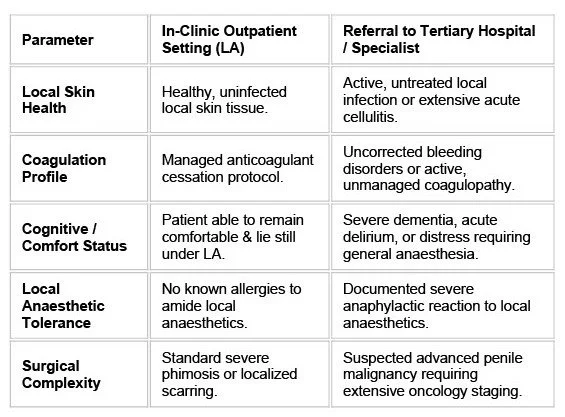
3. Streamlined Pathways for Regional & Rural Victorian Patients
For elderly patients travelling to Hoppers Crossing from regional areas like Daylesford, Tarneit, Geelong, or the Western District, minimising travel fatigue is crucial:
Initial Telehealth Assessment: Pre-operative reviews can be conducted via telehealth. Dr Tipnis reviews medical histories, current medication lists (including blood thinners), and GP referral notes to confirm procedural suitability before the patient travels.
GP Collaboration: We liaise directly with the patient's local rural GP to confirm recent blood work (such as kidney function tests) and coordinate the exact timing for withholding medications.
Same-Day Return Home: The procedure is completed under a localised nerve block within 20 to 30 minutes. After a short observation window to confirm complete bleeding control, the patient can return home comfortably in the care of a support driver.
4. Post-Operative Care for Elderly Patients
Healing timelines in older tissue require gentle, consistent home care:
Friction Protection: Applying generous layers of petroleum jelly (Vaseline) prevents healing skin margins from adhering to underwear.
Positioning & Rest: Elevating the lower body and resting for 48 hours post-procedure minimises localised swelling.
Clear Aftercare Communication: Written instructions and direct clinic phone support ensure regional patients and their carers feel fully supported once they return home.
Clinical Practice Disclosure: Dr Rahul Tipnis is a registered General Practitioner (FRACGP) with an audited clinical record of over 900 circumcisions. He is not a specialist urologist or plastic surgeon. Procedures at CircVas Doctor are performed following a thorough clinical evaluation for verified medical, cultural, or religious indications.
Arranging a Consultation
If you, a family member, or a patient requires a pre-operative evaluation for medical circumcision—including those travelling from regional Victoria or managing complex medical backgrounds—contact our clinical team.
📞 Contact CircVas Doctor: 1300 714 358
📍 Clinic Location: Harmony Health Medical Centre, 46 Hogans Road, Hoppers Crossing VIC 3029
(Welcoming patients from Hoppers Crossing, Werribee, Geelong, Daylesford, Ballarat, and regional Victoria).
⚠️ Mandatory Medical Disclaimer
This publication is intended strictly for general educational purposes and does not substitute for a direct medical consultation, diagnosis, or personalised treatment plan. All minor surgical procedures carry inherent clinical risks—including localised bleeding, hematoma formation, infection, temporary swelling, or altered cosmetic healing. A formal, mandatory face-to-face clinical evaluation and consultation are required before rebate eligibility or surgical scheduling can be confirmed. Dr Rahul Tipnis is a registered General Practitioner (FRACGP, AHPRA Registration: MED0001552566). He does not perform cosmetic circumcisions; all procedures are performed strictly for verified medical, cultural, or religious indications. Individual recovery outcomes vary. Patients and guardians are always encouraged to seek an independent second opinion from a qualified health practitioner regarding surgical interventions.
