
Sperm Banking Before Vasectomy: An “Insurance Policy” for Peace of Mind
Written by Dr Rahul Tipnis, FRACGP | Date: 27/09/2026
Deciding to undergo a no-scalpel vasectomy is a significant milestone for men and couples who feel confident they have completed their families. However, even when a decision feels 100% right today, many men hesitate because the future is unpredictable.
To alleviate anxiety about life changes, some men explore sperm banking (cryopreservation) prior to their procedure. This article provides a clear, objective overview of how sperm banking works alongside a vasectomy, its pros and cons, and how it compares to post-vasectomy reversal.
What Is Sperm Banking Before Vasectomy?
Sperm banking involves providing a semen sample to an accredited fertility laboratory before undergoing a vasectomy. The sample is analysed, frozen in liquid nitrogen at extreme temperatures (-196°C), and kept in secure long-term storage.
If life circumstances change years later and a man decides he wants another biological child, the stored sperm can be thawed and used in assisted reproductive treatments—such as In Vitro Fertilisation (IVF) or Intrauterine Insemination (IUI).
Why Do Some Men Choose to Bank Sperm?
While a vasectomy must always be approached as a permanent procedure, banking sperm serves as an anatomical "insurance policy" for specific scenarios:
Life Uncertainty & Change: Protection against unexpected life events, such as a change in relationship status or the loss of a child.
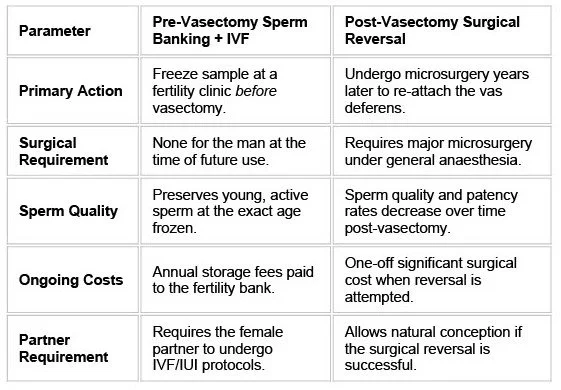
Avoiding Surgical Reversal: Vasectomy reversal (vasovasostomy) is a complex, delicate micro-surgery that requires general anaesthesia, carries high out-of-pocket costs, and sees success rates decline the longer it has been since the original vasectomy.
Peace of Mind: Knowing a preserved sample exists allows some men to move forward with their vasectomy booking without residual "what-if" anxiety.
Comparing Your Future Options: Sperm Banking vs. Vasectomy Reversal
If a man wishes to father a child after a vasectomy, two main clinical pathways exist:
How the Sperm Banking Process Works in Victoria
If you decide to bank sperm before your vasectomy, the standard pathway involves:
GP Referral & Pathology Screening: Ask your GP for a referral to an accredited fertility facility in Melbourne (such as Monash IVF, City Fertility, or Melbourne IVF). Screening blood tests (for blood-borne viruses) are required prior to storage.
Sample Collection & Analysis: You provide a fresh sample at the facility. The lab evaluates sperm count, motility, and health before cryopreservation.
Storage & Consent: You sign a consent agreement defining how long the sample will be kept (typically up to 10 years, which can be extended) and pay the initial processing and annual storage fees.
Realistic Considerations to Keep in Mind
While sperm banking offers peace of mind, it is important to evaluate the practicalities:
Storage Fees: Fertility banks charge ongoing annual fees to maintain frozen samples (typically ranging between $250 and $400 per year).
Future IVF Requirements: Using stored sperm requires your partner to undergo assisted reproduction (IUI or IVF), which involves medical procedures, hormones, and financial costs.
No Guarantee: While cryopreservation technology is highly advanced, not all sperm survive the freeze-thaw process, and pregnancy through IVF is never 100% guaranteed.
Clinical Guidance: Sperm banking should be viewed as a backup precaution, not a reason to move forward with a vasectomy if you are genuinely uncertain about permanent contraception. If you feel hesitant about completing your family, temporary contraceptive methods should be maintained until you achieve total certainty.
Practice Credentials & Safety Disclosures
Dr Rahul Tipnis (MBBS, MS, FRACGP) is a registered General Practitioner with an audited clinical record of over 200 no-scalpel vasectomies. He is not a specialist urologist or fertility specialist.
A no-scalpel vasectomy is an outpatient procedure performed under local anaesthesia and must be treated as an irreversible decision. All surgical procedures carry inherent clinical risks—including localised bleeding, hematoma, infection, temporary swelling, post-vasectomy pain syndrome, and a low statistical risk of procedural failure or late recanalisation.
A formal pre-operative consultation is mandatory. Alternative contraception must continue uninterrupted until a post-vasectomy semen analysis at 3–4 months confirms complete clearance (azoospermia).
Arranging a Consultation in Melbourne’s West
If you are considering a no-scalpel vasectomy and wish to discuss procedural steps, recovery, or family planning considerations, contact our clinical team.
📞 Contact CircVas Doctor: 1300 714 358
📍 Clinic Location: Harmony Health Medical Centre, 46 Hogans Road, Hoppers Crossing VIC 3029
(Serving men across Hoppers Crossing, Truganina, Tarneit, Werribee, Point Cook, and greater Melbourne).
⚠️ Mandatory Medical Disclaimer
This publication is intended strictly for general educational purposes and does not substitute for direct medical diagnosis, advice, or a personalized treatment plan. All minor surgical procedures carry inherent clinical risks—including localised bleeding, hematoma formation, infection, temporary swelling, chronic post-vasectomy pain syndrome, and a low statistical risk of failure or recanalisation. A formal, mandatory face-to-face clinical evaluation and consultation are required before any procedure can be scheduled. Dr Rahul Tipnis is a registered General Practitioner (FRACGP, AHPRA Registration: MED0001552566). No-scalpel vasectomy procedures are performed exclusively for verified family planning indications. Individual recovery outcomes vary. Patients are always encouraged to seek an independent second opinion from a qualified health practitioner regarding surgical interventions.
