
Post-Vasectomy Exercise Mechanics: Why Cycling and Heavy Deadlifts Threaten Early Healing
Written by Dr Rahul Tipnis, FRACGP | Date: October 18, 2026
For active men, gym-goers, runners, and cyclists, taking time off from physical training after a no-scalpel vasectomy can feel frustrating. A common question during pre-operative reviews at CircVas Doctor is why light walking is permitted almost immediately, while exercises like heavy deadlifts, squats, or road cycling are strictly off-limits during the first 2 to 3 weeks.
Understanding the underlying physiological and biomechanical forces created by specific movements—most notably the lumbar pose/bracing during heavy compound lifting and direct saddle pressure during cycling—explains why resuming high-impact exercise too early directly threatens early wound healing and increases post-operative complications.
This clinical guide breaks down the exercise mechanics behind vasectomy recovery and provides a structured return-to-fitness roadmap.
The Biomechanics of Heavy Lifting: The "Lumbar Pose" & Intra-Abdominal Pressure
When performing heavy compound exercises such as deadlifts, squats, or overhead presses, lifters naturally adopt a rigid "lumbar pose"—hyperextending or bracing the lumbar spine while taking a deep breath and contracting the core muscles. This technique is known medically as the Valsalva maneuver.
How Intra-Abdominal Pressure Affects Scrotal Healing
Valsalva / Lumbar Pose: Deep breath + core brace -> Massive spike in Intra-Abdominal Pressure (IAP).
Venous backpressure: High IAP compresses pelvic veins, causing a sudden reverse pressure wave down the spermatic cord.
Micro-vessel strain: Fragile, newly sealed micro-vessels in the vas deferens are forced open.
Clinical Outcome: High risk of acute scrotal hematoma or severe scrotal congestion.
1. Spiking Intra-Abdominal Pressure (IAP)
Bracing your core during a heavy deadlift or squat dramatically increases pressure inside your abdominal and pelvic cavities. This spike in intra-abdominal pressure (IAP) stabilises the lumbar spine, allowing you to lift heavy weight.
2. Retrograde Venous Surge
The veins that drain blood from the testicles and vas deferens (the pampiniform plexus) run directly through the inguinal canal into the abdomen. When abdominal pressure spikes during a heavy lift, blood flow returning from the scrotum to the heart is temporarily blocked or forced backward (retrograde surge).
3. Disruption of Healing Micro-Vessels
During a no-scalpel vasectomy, tiny blood vessels surrounding the vas deferens are divided and cauterised or tied off. During the first 7 to 14 days, these microscopic seals are fragile. A sudden surge in pelvic venous pressure can rupture these delicate micro-vessels, causing blood to pool inside the loose tissue of the scrotum—leading to an acute scrotal hematoma.
Why Cycling and Saddle Pressure Threaten Recovery
While heavy lifting threatens healing through internal blood pressure spikes, cycling threatens recovery through direct external mechanical force.
1. Direct Perineal and Scrotal Compression
Sitting on a bicycle saddle places a significant portion of your body weight directly on the perineum (the area between the scrotum and anus) and the inferior scrotal wall. This directly compresses the healing vas deferens ends and delicate surgical puncture site against the hard saddle nose.
2. Constant Repetitive Shear Stress
The pedalling motion creates continuous, repetitive friction and shear forces across the scrotum. This friction pulls on the healing skin puncture, increases localised tissue inflammation, and significantly raises the risk of wound breakdown or local bacterial infection.
3. Aggravation of Epididymal Congestion
Placing direct pressure on the testicles while blood flow is restricted by saddle contact worsens natural post-vasectomy epididymal congestion, causing intense, prolonged scrotal aching during or after your ride.
Exercise Mechanics Comparison
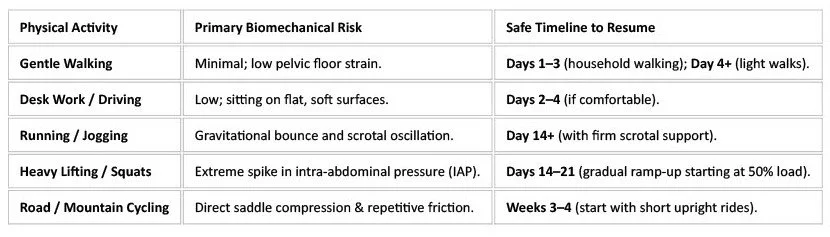
A Structured 3-Week Return-to-Fitness Roadmap
To protect your surgical outcome while maintaining your physical conditioning, follow this phased return-to-exercise framework:
Phase 1: Absolute Physical Rest (Days 1 to 3)
Activities: Complete physical rest. Limit movement to light walking around your home.
Goal: Allow initial micro-vessel clotting and puncture closure to consolidate without disruption.
Gear: Wear firm, supportive briefs or compression shorts continuously (24/7).
Phase 2: Low-Impact Mobility (Days 4 to 7)
Activities: Leisurely outdoor walking on flat surfaces (15 to 30 minutes max). Light upper-body mobility stretches (no core bracing).
Restrictions: Strictly NO running, jumping, heavy lifting (>5–10 kg), or sports.
Phase 3: Gradual Resistance & Cardio Return (Days 8 to 14)
Activities: Light bodyweight exercises, treadmill walking at an incline, or stationary upper-body machine weights (seated, low weight, high reps, no core straining).
Restrictions: Avoid heavy compound lifts (deadlifts, barbell squats), high-intensity interval training (HIIT), and cycling.
Phase 4: Full Activity Transition (Week 3 Onward)
Activities: Reintroduce running, compound weightlifting, and cycling.
Key Guidelines: Start at 50% of your pre-surgery weight/intensity and increase gradually over 7 to 10 days. Always wear snug, supportive underwear during workouts to prevent scrotal movement.
Practice Credentials & Safety Disclosures
Dr Rahul Tipnis (MBBS, MS, FRACGP) is a registered General Practitioner with an audited clinical record of over 200 no-scalpel vasectomies. He is not a specialist urologist or surgeon. Procedures at Circ Vas Doctor are performed exclusively for voluntary family planning indications following a comprehensive pre-operative evaluation.
All surgical procedures carry inherent clinical risks—including localised bleeding, hematoma formation, wound infection, temporary swelling, chronic post-vasectomy pain syndrome, and a low statistical risk of procedural failure or late spontaneous recanalisation.
A formal pre-operative consultation is mandatory. Alternative contraception must continue uninterrupted until a post-vasectomy semen analysis at 3 to 4 months confirms complete clearance (azoospermia). Patients are always encouraged to seek an independent second opinion from a qualified health practitioner.
Arranging a Pre-Operative Consultation
If you are an active man considering a no-scalpel vasectomy and wish to discuss procedural timing, exercise modifications, or recovery protocols, contact our clinical team in Melbourne’s west.
📞 Contact CircVas Doctor: 1300 714 358
📍 Clinic Location: Harmony Health Medical Centre, 46 Hogans Road, Hoppers Crossing VIC 3029
(Serving active men across Hoppers Crossing, Truganina, Tarneit, Werribee, Point Cook, Geelong, and regional Victoria).
⚠️ Mandatory Medical Disclaimer
This publication is intended strictly for general educational purposes and does not substitute for direct medical diagnosis, advice, or a personalized treatment plan. All minor surgical procedures carry inherent clinical risks—including localized bleeding, hematoma formation, infection, temporary swelling, chronic pain, and a low statistical risk of failure or recanalisation. A formal, mandatory face-to-face clinical evaluation and consultation are required before any procedure can be scheduled. Dr Rahul Tipnis is a registered General Practitioner (FRACGP, AHPRA Registration: MED0001552566). No-scalpel vasectomy procedures are performed exclusively for verified family planning indications. Individual recovery outcomes vary. Patients are always encouraged to seek an independent second opinion from a qualified health practitioner regarding surgical interventions.
