
No-Scalpel Vasectomy Minimally Invasive | Circ VAs Doctor
Written by Dr Rahul Tipnis, FRACGP | Date: 7th June 2026
A no-scalpel vasectomy is a minor, outpatient surgical procedure utilised as a dependable, long-term method of male family planning. At CircVas Doctor in Hoppers Crossing, Dr Rahul Tipnis utilises this minimally invasive puncture technique to prioritise clinical precision, patient comfort, and a structured recovery for men residing across Melbourne’s western suburbs—including Hoppers Crossing, Werribee, Point Cook, Tarneit, and Truganina.
This webpage provides general, evidence-based educational information regarding the no-scalpel vasectomy protocol. It is not a substitute for a personalised medical consultation. A mandatory, pre-operative clinical evaluation with Dr Tipnis is required to review your medical history, discuss the permanent nature of the procedure, and ensure your suitability.
What is a No-Scalpel Vasectomy?
The no-scalpel vasectomy technique represents a significant evolution from traditional incisional methods. Rather than using a scalpel to make incisions on either side of the scrotum, this technique utilises a specialised, blunt-tipped instrument to create a single, tiny puncture in the skin.
Through this single opening, both the left and right vas deferens (the tubes that transport sperm) are gently accessed, divided, and sealed to prevent sperm from entering the ejaculate.
Clinical Attributes of the No-Scalpel Technique:
Suture-Free Healing: The puncture site is so small that it typically seals naturally within days, eliminating the need for external surgical stitches.
Reduced Tissue Disruption: Minimising trauma to localised skin and blood vessels significantly lowers post-operative complication rates—such as severe bruising, hematoma formation, and localised infections—compared to traditional methods.
Localised Anaesthesia: The entire procedure is performed under a highly effective local anaesthetic block, meaning you remain fully awake and comfortable throughout.
Time Efficiency: The outpatient procedure is completed in a clinical room, typically taking between 15 to 20 minutes.
Important Practice Profile: Dr Rahul Tipnis is a General Practitioner (FRACGP), not a specialist urologist or plastic surgeon. All procedures at our clinic are performed strictly for voluntary family planning indications following a thorough, informed consent process.
The Care Pathway: What to Expect
1. Mandatory Pre-Operative Consultation
Before booking your procedure, a confidential consultation is conducted. Dr Tipnis will evaluate your eligibility, outline the surgical anatomical process, answer questions, and detail the minor risks involved.
2. The Day of the Procedure
The localised area is thoroughly numbed using a local anaesthetic injection. Once optimal numbing is achieved, the puncture is performed, the tubes are divided and sealed, and a protective layer is placed over the site. You are fit to return home shortly after completion.
3. Crucial Post-Operative Semen Analysis
A vasectomy is not immediately effective. Sperm remains stored in the upper portions of the vas deferens for several weeks following the procedure. You must continue to use an alternative, highly reliable form of contraception until you complete a follow-up semen analysis—typically ordered 8 to 12 weeks post-procedure—and receive formal, written clearance from our clinic confirming that zero viable sperm remain.
Recovery and Activity Guidelines
While individual healing rates vary based on personal health status and occupational demands, a structured recovery protocol supports optimal tissue healing:
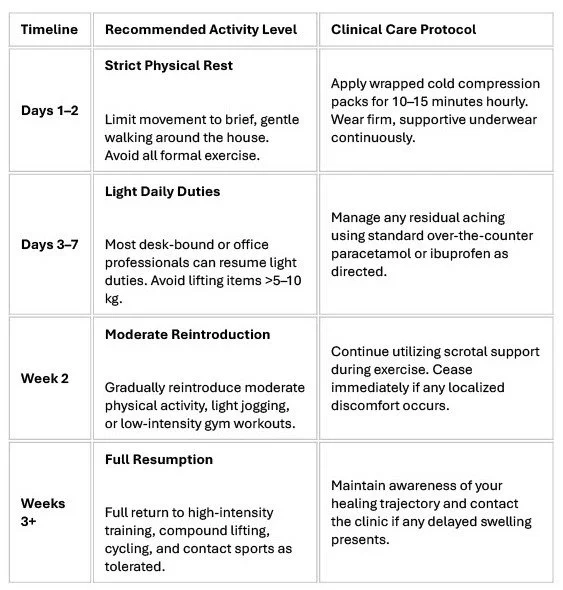
Recovery Time Line
Note: Sexual activity should generally be deferred for approximately 7 days following the procedure to ensure the divided tissue ends remain undisturbed during early healing.
Frequently Asked Questions (FAQs)
Q: Can I drive myself home after the procedure? A: No. Even though the procedure is performed under local anaesthetic, we require all patients to arrange for a support driver or a commercial ride-share service to transport them home safely.
Q: How long do I need to take off work if my job involves manual labour? A: If your trade or occupation requires constant heavy lifting, pulling, or strenuous physical exertion, you should plan for 5 to 7 days of leave or modified light duties. A medical certificate can be provided during your clinical consultation.
Q: Will a vasectomy affect my testosterone levels or sexual function? A: No. A no-scalpel vasectomy solely interrupts the transit of sperm. It has no clinical impact on the production of male hormones (testosterone), your libido, or the mechanics of erection and ejaculation.
Arranging a Consultation in the Western Suburbs
If you are considering a permanent family planning solution, you can arrange a confidential pre-operative consultation with Dr Rahul Tipnis at our Hoppers Crossing medical facility.
📞 Contact CircVas Doctor: 1300 714 358
📍 Clinic Location: Suprema Medical Centre 583, Tarneit Road Hoppers Crossing Victoria 3029
⚠️ Mandatory Medical Disclaimer
This publication is intended strictly for general educational purposes and must not be used as a substitute for direct medical diagnosis or a personalised treatment plan. All surgical procedures carry inherent clinical risks, including localised bleeding, hematoma formation, infection, post-operative bruising, sperm granuloma, temporary swelling, chronic post-vasectomy pain syndrome, and a low risk of failure or spontaneous recanalisation. A formal, mandatory clinical evaluation and consultation are required before any procedure can be scheduled. Dr Rahul Tipnis is a registered General Practitioner (FRACGP, AHPRA Registration: MED0001552566). No-scalpel vasectomy procedures are performed exclusively for verified family planning indications. Individual recovery outcomes vary. Patients are always encouraged to seek an independent second opinion from a qualified health practitioner regarding surgical interventions.
